The team sees a 15.4% corridor on TCL 98" QLED. Pro frames the question: is this real market pressure, or a noisy reference that should not drive price action yet?
CategoryVantage Scenario Workspace
Replay the commercial move before the team acts on it.
Scenario Workspace is the Pro operating layer for reusable TV category decisions: build a rule, replay it against market evidence, hold weak references, and activate only after source checks clear.
Build
Replay
Gate
Activate only when ready
Pro case replay
TCL 98" QLED: the gap looked urgent; replay kept it out of a premature markdown.
A public-market scan surfaced a two-source 15.4% corridor on a high-ticket premium TV. Core can put the event in the weekly memo. Pro turns the same pattern into a reusable scenario: test the pressure, hold weak references, and only promote the operating rule when the reference is clean enough.
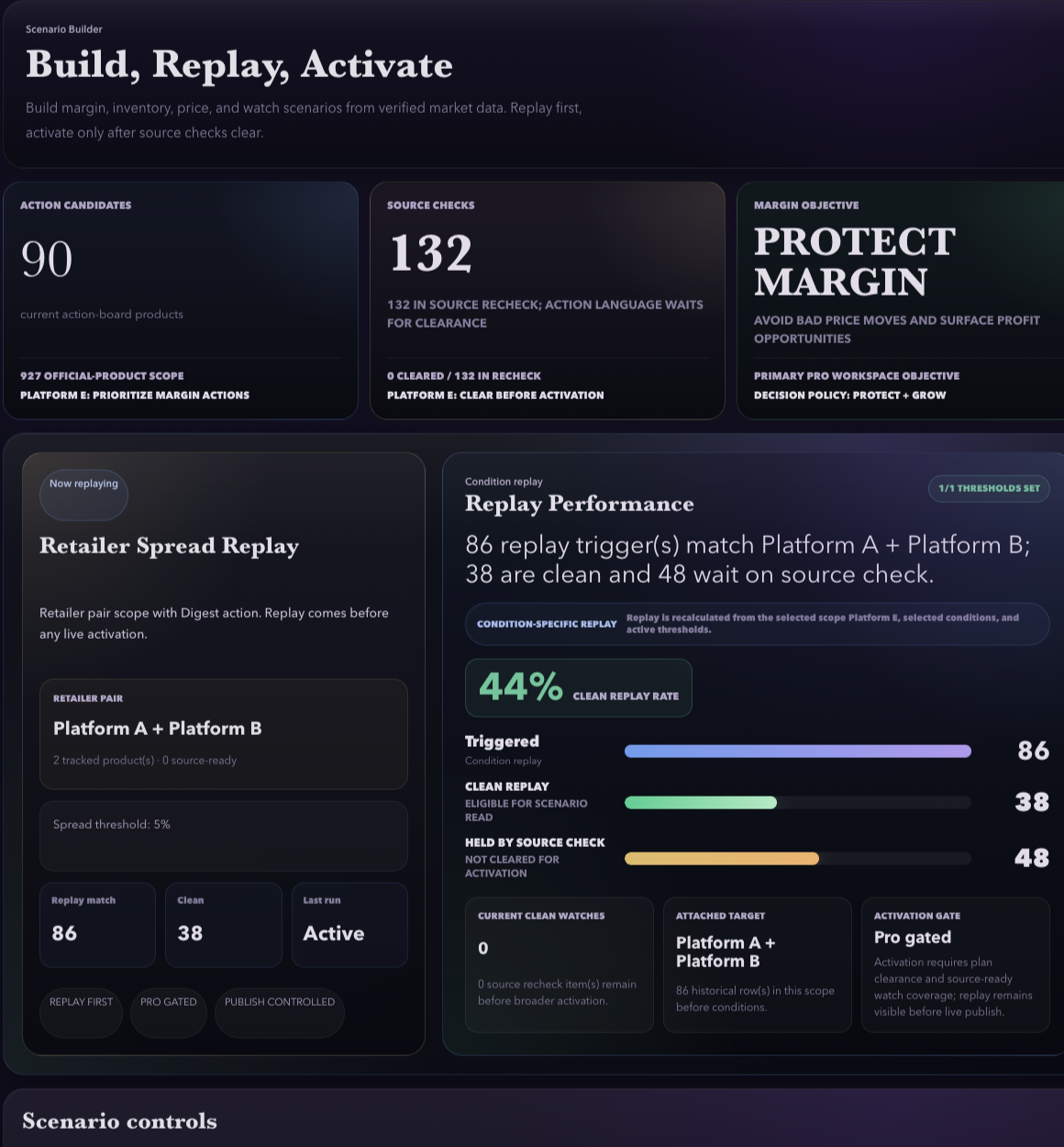
Candidate moments replayed
86
Market moments reviewed without asking the team to inspect every row.
Clean enough to brief
38
Only cleaner cases move toward memo-ready commercial discussion.
Premature moves held
48
Questionable signals stay out of price, stock, or account action until proof improves.
One complete replay loop
Pressure event to operating rule, without pretending every gap is a decision.
This is the Pro difference: the team does not just receive a memo sentence. It gets a standing scenario that can be replayed as price, seller, stock, and source evidence changes.
Replay checks identity, seller, condition, availability, and freshness before anyone turns the spread into a pricing, stock, promo, or account move.
The read still informs planning, but it avoids a weak markdown, stock shift, or account escalation when the source still needs proof.
Next time similar pressure appears, the memo can show what cleared, what stayed held, and whether the account should defend, watch, recheck, or escalate.
Replay first, activate later.
Scenario Workspace keeps the rule ready before the team commits. That means faster meetings, fewer one-off analyses, and fewer price moves made from weak evidence.
Held does not mean useless. It means not action-safe yet.
A held signal still has planning value; it simply does not become a commercial instruction yet. That protects margin and trust at the same time.
Exceptions become reusable category routines.
Promo windows, stock pressure, spread thresholds, competitor corridors, and priority SKU exceptions come back every week. Pro gives them a standing place.
Promise discipline
The public replay shows the operating shape. Customer calibration makes it account-specific.
CategoryVantage can identify market pressure, weak references, and watch lanes from public evidence. Customer context makes the same read practical for the buyer: margin band, inventory, velocity, promo calendar, priority account, and competitor set decide whether to defend, watch, recheck, or escalate.
During Pro fit review, thresholds and action language are calibrated before live activation. Until those rules are approved, the system stays in replay, memo, and source-check language instead of promising automatic savings.
Why this belongs in Pro
Scenario Workspace is the difference between receiving a memo and running a governed category operating layer.
- Core gives the team a focused weekly read.
- Pro turns repeated questions into reusable rules the team can keep using.
- Leadership sees which moves were cleared, which were held, and why.
- Teams spend less time rebuilding the same analysis before every meeting.